





Generative AI changed the conversation. Suddenly, every boardroom wants a chatbot, every strategy deck mentions “GPT”, and every vendor has an AI story. Fair enough. The technology is real, and it is useful.
But it sits on top of a stack. And if you want AI that actually delivers business value, you need to understand that stack from the bottom up.
What is the AI stack?
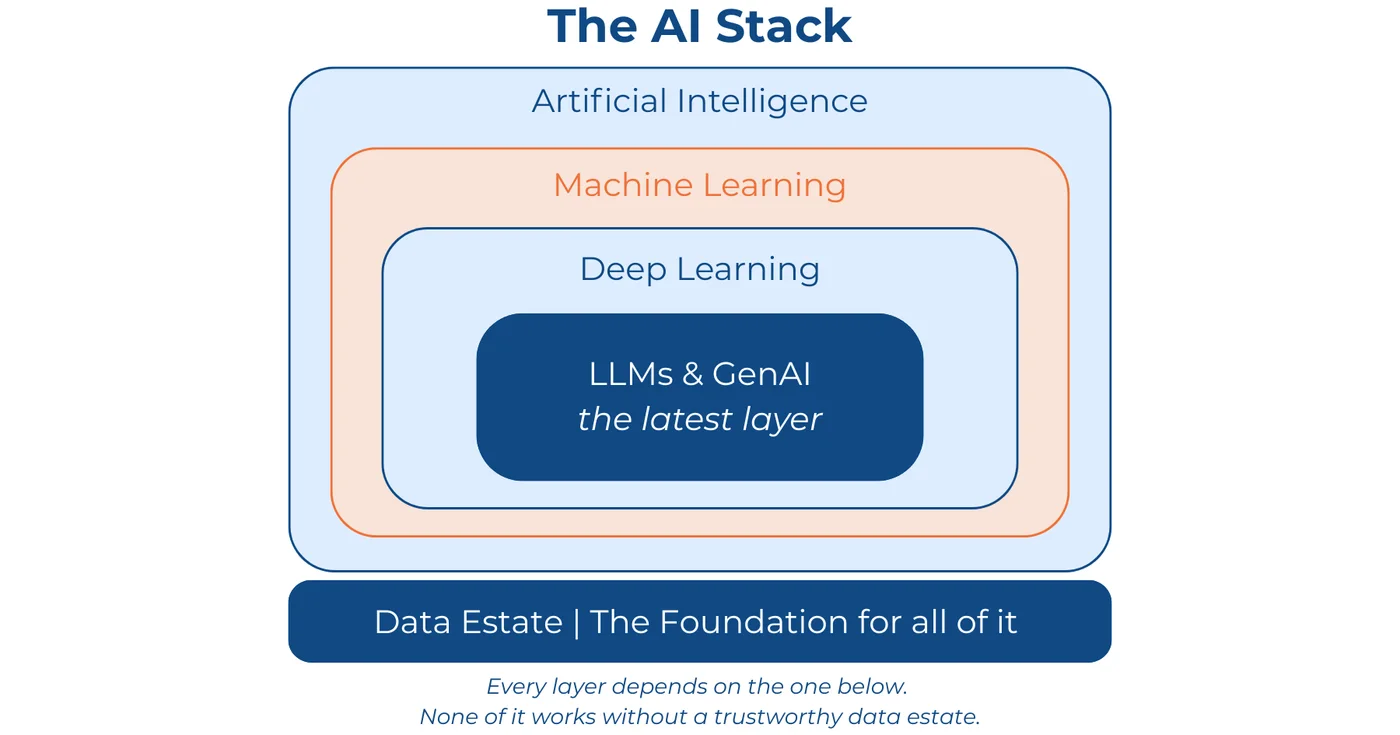
Artificial intelligence is the umbrella. Inside it lives machine learning (ML), decades of algorithms that learn patterns from data. Inside ML lives deep learning, the neural networks that handle images, speech and sequences. And inside deep learning sits the latest layer: large language models (LLMs) and generative AI.
Every layer depends on the one below, and none of it works without the foundation underneath all of them: a trustworthy data estate.
Machine learning vs LLMs: did LLMs replace ML?
This is the misconception we hear most often. A client will say, “We want to use AI”, and mean “We want to use ChatGPT.” Sometimes that is the right answer, but often it is not.
Large language models are one application of deep learning. They are exceptional at understanding and generating natural language, but they are not the best tool for every decision your business needs to make.
Traditional machine learning, trained on your own structured data, deployed in your own stack and monitored in production, still produces the credit scores, fraud signals, churn predictions and pricing decisions that earn their keep quarter after quarter.
The right question is not “LLM or ML?” It is “Which tool fits this problem?” And often the answer is both, working together.
Where traditional machine learning still delivers business value
ML belongs where there is structured data and well-defined decisions. If that criteria is met, ML is not going anywhere.
Proven ROI from ML models
Think credit scoring, fraud detection, churn prediction, pricing and underwriting. These are decisions trained on your history, deployed in your environment and monitored over time. The savings, revenue gains and risk reductions follow directly.
Measurable model accuracy
Decades of established metrics like AUC, Gini, calibration, precision, recall and lift let you measure how a model performs, defend the number to a regulator, and track it across months and years. LLM evaluation, by contrast, is still much messier and more subjective.
Fast, cheap, and in your control
An ML model scoring a million transactions a day runs at a fraction of the cost and latency of an LLM API call. For repeatable decisions at volume, traditional machine learning keeps costs low and responses fast.
How machine learning and LLMs work together
The most effective AI systems we build today combine both ML and LLMs, on top of a real data estate.
Pattern 1: LLMs over your ML models and data
Chat-with-your-data and agentic AI interfaces sit on top of data warehouses, semantic layers and ML models. The LLM translates natural language into queries and actions, while the model and the data remain the source of truth.
Pattern 2: LLMs feed ML pipelines
Use an LLM to extract structure from documents, calls and free text, then let a tuned ML model handle the actual decision. You get coverage from the LLM and accuracy from the model.
Pattern 3: ML keeps LLMs honest
Classifiers, anomaly detectors and retrieval scorers sit between the LLM and the user, catching hallucinations and unsafe outputs before they reach production. The LLM generates. The ML model guards.
Why your data estate is the foundation for AI
None of this works without clean, governed data. Not the machine learning, not the LLMs, not the agentic AI future everyone is talking about. A strong data estate is what makes any of it real. Without it, traditional ML stalls and LLMs hallucinate. With it, both produce results you can actually use.
Every intelligent AI solution starts with connected data. If your data is siloed, ungoverned or unreliable, the fanciest model in the world will not save you.
Pick the right AI tool for the decision
Sometimes that is an LLM. Sometimes it is a well-trained machine learning model. Often, it is the two of them working together, on a foundation of clean data.
Praelexis has been building traditional machine learning solutions in production since 2012. We have a clear view of where LLMs add value and where they do not. We are one partner for the full AI stack: data engineering, machine learning and LLM solutions, chosen for the problem, built end-to-end and operated in production. Take the AI Readiness Assessment: twelve questions, under five minutes. An honest read on whether your data, team and use case are ready for ML, for LLMs, or both.