





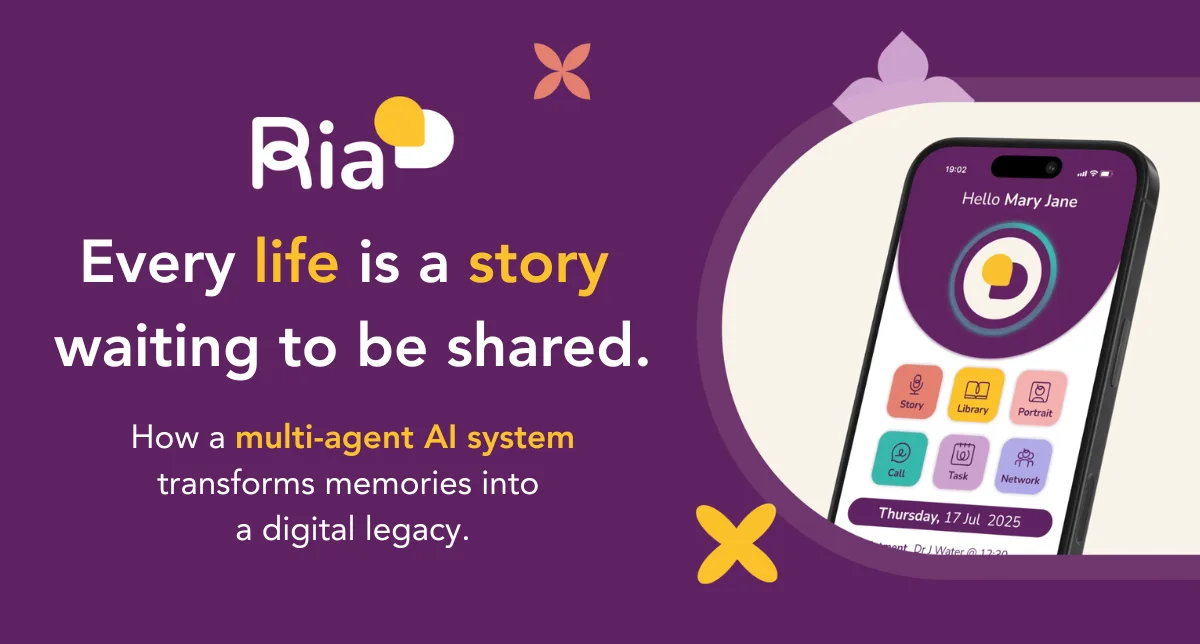
Right now, someone’s grandfather is sitting in a living room with sixty years of stories locked inside him. These are stories his family wants to remember. But nobody has documented it. This is about to change.
The brief that stopped us in our tracks
Our German partner’s request was deceptively simple: build an app that lets elderly people talk to an AI companion and, through natural conversation, capture their life stories. The app should also coordinate their care, manage reminders, and connect them with family.
The real challenge wasn’t the technology. We weren’t building a chatbot. We were building something that needed to earn the trust of an 82-year-old, coax out memories, and do all of this through voice, because typing is not the most intuitive communication method.
Why voice changes everything
Most AI applications are built around text. Typing a prompt to get a response is an interaction model that works brilliantly for knowledge workers, developers, and digital natives. It is entirely useless for a retired schoolteacher who wants to tell someone about the day she met her husband at a dance in 1963.
For Ria, the app we built, voice is foundational. The entire system is designed around voice-to-voice interaction, using Agentic AI to guide conversations naturally. Ria does not interrogate the user. She prompts gently and listens. She circles back to the threads the user mentioned three conversations ago, and gradually, organically, a life story emerges.
This is fundamentally different from anything else in the market. Competitors offer journalling apps that require typing, or simple voice recorders that produce hours of unstructured audio nobody will ever listen to. Ria captures stories through dialogue and structures them into something meaningful: a biography that family members can actually read, listen to, and respond to.
Agentic AI: the architecture that makes it possible
This is where the project gets interesting for anyone building or investing in AI. Ria is not a single model doing one thing. It is a multi-agent system built on an Agentic AI framework, where specialised AI agents collaborate in real time, each handling a different dimension of the user experience. Think of it less like a chatbot and more like a small, coordinated team, each member with a specific role, working together seamlessly behind a single conversational interface.
The Story Agent manages the life story conversation itself. This is the most technically demanding piece. It needs to guide dialogue without making it feel guided, prompting naturally, recognising when a user has touched on something worth exploring deeper, and weaving separate conversations held days or weeks apart into a coherent narrative. It must understand not just what someone says, but what they almost said, and find a way back to it later.
The Care Agent handles the practical side of medication reminders, appointment scheduling, and preference tracking. But here is what makes this agentic rather than simply automated: the Care Agent learns from the Story Agent. When a user mentions in a life story conversation that they hate being woken early, or that they always drank rooibos rather than coffee, that preference data flows into the care profile. The agents share context, and the system gets smarter with every interaction.
The Connection Agent manages the family network, enabling children and grandchildren to access their loved one’s stories almost like a family podcast, facilitating video calls, and creating a shared space where family members can respond with their own reflections and memories.
The critical design decision was to make these agents interactive and guiding the hand-offs between agents. Each agent can initiate actions, make contextual decisions, and adapt its behaviour based on what the other agents are learning. The Story Agent does not follow a script. It follows the person. And when it encounters something that matters to the Care Agent (a food preference, a daily routine, a source of anxiety), it passes that information along without breaking the flow of conversation.
This is what distinguishes Agentic AI from the prompt-and-response model most people associate with large language models. The agents are not waiting to be told what to do. They are actively sensing, interpreting, and acting within their domains while coordinating with one another to deliver a unified experience. All while learning from the feedback they get.
The multi-language challenge
The system needed to work in German from day one, with the architecture flexible enough to support additional languages as the product scales. This is not a case of bolting a translation layer onto an English-language product. The conversational AI needed to understand cultural context, idiomatic expression, and the particular way people reminisce in their mother tongue.
Building audio-to-audio capability across languages adds another layer of complexity. The system processes spoken English, German, or Afrikaans, interprets meaning and emotional tone, generates a contextually appropriate response, and delivers it as natural-sounding speech, all in near real time. Each of those steps involves a different model working in concert, orchestrated by the agentic framework.
Challenging the assumptions
In developing Ria, we encountered two persistent myths that often hinder innovation in this space. We decided to put them to the test, and the results were quite revealing.
The first assumption is that AI cannot be truly secure or private. Ria operates under the rigorous frameworks of GDPR and POPIA, ensuring that personal data is handled with the highest global standards of legal and ethical care. We built what we call an approved network model: your stories are not broadcast to the world. They exist within a closed-loop system where life stories are shared exclusively with people you have approved. Strict access controls ensure that the most personal parts of a legacy remain protected and private. AI can be secure. It simply has to be built that way from the start.
The second assumption is that the elderly are tech-resistant and incapable. The stereotype suggests that older generations are clueless when it comes to technology, or simply unwilling to engage with it. Our research proved the exact opposite. Our oldest test subject was 100 years old, and she had no problem talking to “the computer” about her life story. In fact, she enjoyed the interactive nature of the app immensely.
Through dedicated focus group research, we found that when the interface is natural, like conversation, the tech barrier disappears entirely. Seniors are not resistant to technology. They are resistant to badly designed technology. When the tool provides immediate emotional value, like preserving a memory, they embrace it. Age is not a barrier to digital adoption.
What Ria tells us about where AI is heading
There is a tendency in the AI industry to evaluate applications by their technical sophistication, model size, benchmark scores, and inference speed. And there is value in that, but Ria represents something we think is equally important: the maturation of Agentic AI from a research concept into a production system that delivers real value to people who would never describe themselves as technology users.
The multi-agent architecture that powers Ria is the same class of technology being deployed in autonomous coding assistants, financial trading systems, and supply chain optimisation. The difference is the domain, and that difference matters, because it proves that Agentic AI is not limited to technical power users: It can be designed to meet people exactly where they are (even when “where they are” is an armchair in a care home with no prior experience of digital technology).
This is what responsible AI implementation looks like in practice. It is not just about bias audits and ethics boards. It is about asking, at the very start of a project, who this is for, what they actually need, and how they naturally communicate. And then building everything (every agent, every interaction flow, every design decision) from that answer outward.
A Stellenbosch story
Ria holds particular significance for Praelexis because it represents something we believe deeply: that the most powerful AI applications are not those that replace human connection, but those that make it possible.
There is a quiet crisis unfolding alongside the ageing population, one that health professionals have started calling the loneliness pandemic. Social isolation among the elderly is not just an emotional problem. It is a health risk as damaging as smoking fifteen cigarettes a day, according to widely cited research. Ria is built on the conviction that technology can work to create new pathways for connection rather than closing them off. When a grandmother shares a story through Ria and her granddaughter listens to it that evening, the distance between them shrinks. In this instance AI will act as a bridge.
The product is live, with families already using it to bridge the gap between generations. And somewhere in Germany, a grandmother is telling Ria about the day she arrived in a new city with nothing but a suitcase and a name scribbled on a piece of paper. Her granddaughter will listen to that story tonight. She will hear her grandmother’s voice. And for the first time, she will understand where she comes from.
Praelexis is an AI advisory and implementation partner headquartered in Stellenbosch, with offices in Germany. We help companies turn AI into real-world impact. To learn more, visit praelexis.com or take our AI Readiness Assessment.
To learn more about Ria, visit ria-app.com.