




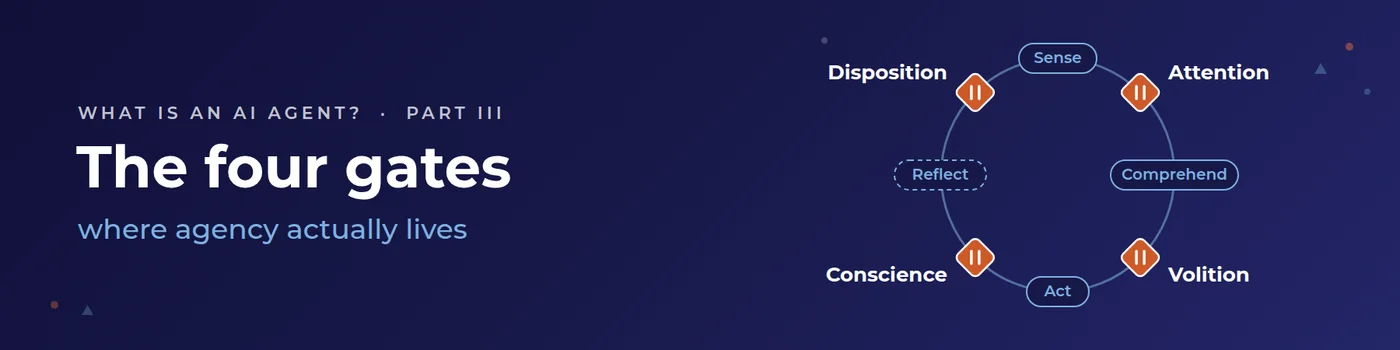
Part I argued that an agent is defined by authority: an objective, incomplete instructions, and the mandate to work out the rest. Part II unpacked the loop an agent runs: sense, comprehend, act, reflect. The blog ended on a claim that needs defending: the four movements are only half the framework. This post supplies the other half.
The arrows are not automatic
Draw the loop, and you will draw four nodes and four arrows. The nodes get all the attention. The arrows look like plumbing: the boring bits that merely connect one movement to the next.
They are not plumbing. In any real agent, each arrow is a gate: a point where the transition can happen, fail to happen, or be refused. Running the cycle is cheap; any decent control system runs it continuously. Your fridge from Part II runs its thin version thousands of times a night. What is rare, and what marks an agent in the full sense, is the capacity to stop mid-cycle for a reason, to hold at a gate rather than being carried through it by momentum.
The four gates have familiar names.
Attention stands between sensing and comprehending. It governs what gets through, which of the thousand things that arrived actually make it into consideration. An agent does not comprehend everything it senses; it comprehends what it attends to.
Volition stands between comprehending and acting. It is the pause between knowing and doing, the moment where understanding either becomes commitment or does not. Everything we mean by “deciding” lives at this gate.
Conscience stands between acting and reflecting. It governs whether the consequences of an action register as mattering, rather than merely as data. An outcome can be measured without being felt; conscience is the gate through which a result becomes a verdict.
Disposition stands between reflecting and the next sensing. It governs whether what was learnt actually reshapes how the agent meets the world next time; the difference between experience and mere repetition. An agent that reflects but never changes its posture has a broken fourth gate.
Every gate fails in two directions
What makes the gates analytically useful, rather than just poetic, is that each one fails in exactly two ways, and the failures are recognisable on sight.
A gate can be forced open from below: attention hijacked by whatever stimulus is loudest; action triggered before understanding has finished; consequences repeated numbly without ever registering; the same mistake made with fresh confidence every quarter. And a gate can fail to open from above: the signal that never gets noticed; the analysis that never becomes a decision; the post-mortem that assigns no weight to what went wrong; the lesson everyone agreed on and nobody absorbed.
Read back over the failures you have seen (in people, in teams, in software systems), and you will find that most of them have a precise gate address. “We had the data, but nobody looked at it” is an attention failure. “We all knew and did nothing” is a volition failure. “The dashboard was red for three weeks, and nobody cared” is a conscience failure. “We did a retro and changed nothing” is a disposition failure. The loop was fine in every one of those cases. The gates were not.
The machine has the operation without the capacity
Now bring this back to AI agents, because here the framework earns its keep.
Modern agentic systems implement every one of the four gates as an engineering feature. Attention is literally a mechanism; the transformer architecture at the heart of today’s models is built from it. Volition appears as permission checkpoints and approval steps: the agent proposes, a policy decides whether it may proceed. Conscience appears as error signals, evaluations and reward functions, the machinery by which outcomes register. Disposition appears as model and memory updates, the mechanism by which this run reshapes the next one.
So has the machine joined us? Looking closer at each gate, a pattern emerges: the machine has the operation without the capacity.
It can be halted by a guardrail, but a guardrail is not a refusal. The stopping is done to the agent by its designers, not by the agent for a reason it weighed. It registers loss, but there is no self for whom the loss is a wound; nothing is at stake for it in its own failure. Its reflection is recursive: output measured against objective, endlessly and precisely, but you cannot optimise your way to a new objective. The one thing its fourth movement can never revise is the standard it was given. And that returns us to Part I’s central point from the other side: however capable the system becomes, the objective stays with the principal. The agent’s norm is held from outside. It is the thermostat’s setpoint, writ very large.
This is not a complaint about today’s models, waiting to be fixed by next year’s. It is a structural observation: the gates are where accountability lives, and accountability cannot be delegated to a system for which nothing can matter.
Design the gates, not just the loop
For anyone building or buying agentic systems, the gates reframe the engineering question. Most agentic AI initiatives obsess over the loop: better sensing (retrieval, integrations), better comprehending (models, prompts), better acting (tools, execution). The loop is table stakes. The systems that behave well in production are the ones where someone deliberately designed the gates:
Attention: what is this agent allowed to see, and what must it never lose sight of? Context curation is a gate decision, not a plumbing detail.
Volition: which actions may the agent take on its own authority, and which require a human signature? This is precisely the mandate design Part I compared to a financial mandate, and it should be drawn up with the same care.
Conscience: which outcomes must register as mattering, and route to a human when they do? An exception queue is a conscience prosthesis.
Disposition: how does this run change the next run, and who reviews what the system is becoming? Unexamined accumulation is how agents drift.
This is what human-in-the-loop design means when it is done seriously: not a human somewhere near the loop, but humans standing at the gates, because in any human–machine system, we are not merely users of the loop. We are its gates. The four movements can increasingly be automated. The four gates are where responsibility lives, and responsibility is the one component that cannot be artificial.