






Most software does what it is told, but AI is different. The properties that make AI powerful are the same properties that make it ethically complex, and understanding them is the first step to managing the risks they introduce.
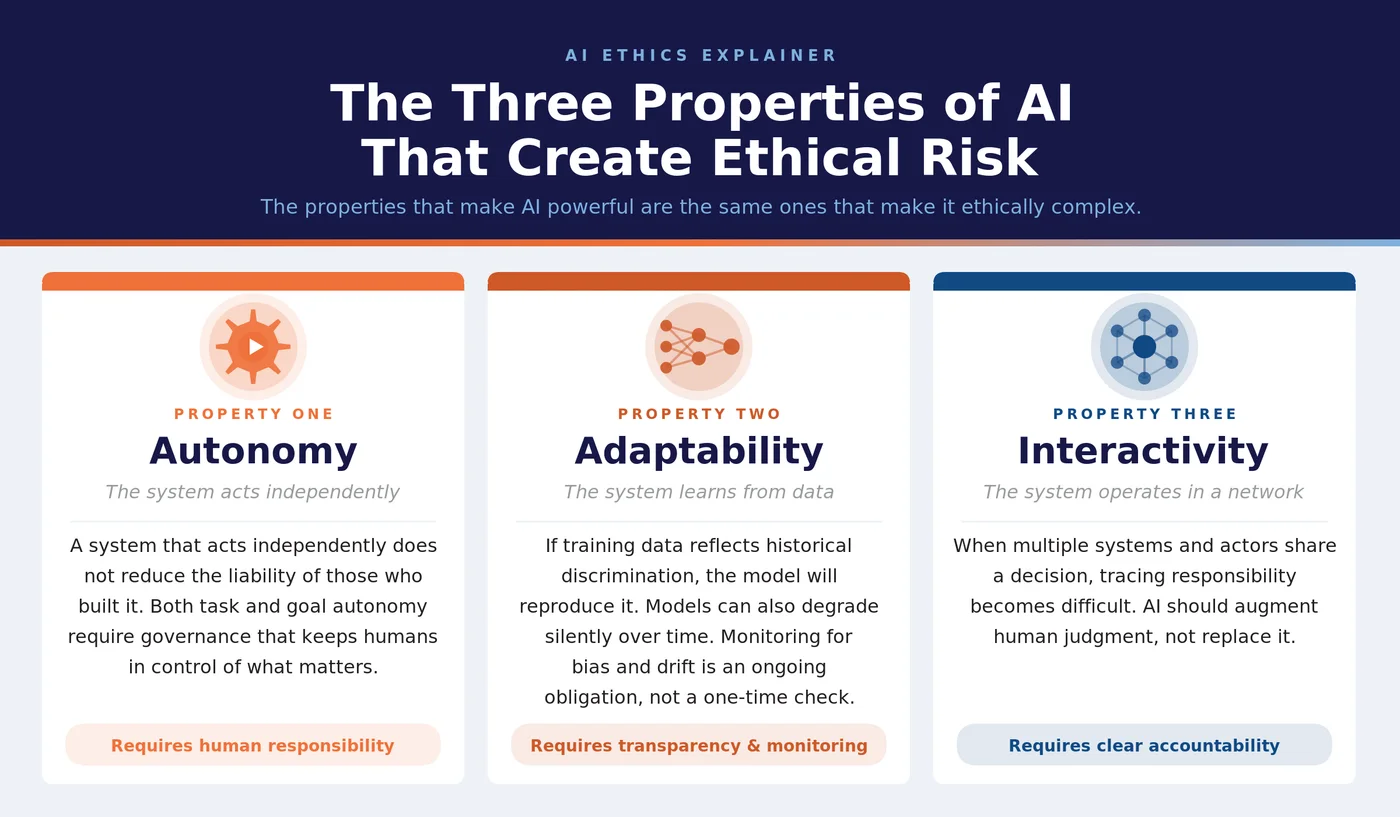
AI and machine learning systems have three defining characteristics: autonomy, adaptability, and interactivity. Each one creates a distinct category of ethical obligation.
1. Autonomy: The System Acts Independently
Autonomy in AI refers to a system’s capacity to act independently and make choices within its defined parameters. Even a relatively simple AI system can operate without human intervention once it has been set in motion. AI agents and Agentic AI systems are prime examples.
This does not mean AI systems are sentient or free. Autonomy in this context is built into the system and results from deliberate choices made by the people who built it. But those choices have consequences that can extend well beyond the original design intent.
The ethical implication is clear: autonomous systems require human responsibility. The fact that a system acts independently does not reduce the liability of the humans behind it. Task autonomy (choosing how to perform a task) and goal autonomy (choosing which goal to pursue) both require governance structures that keep humans in control of what matters.
2. Adaptability: The System Learns from (Possibly Biased) Data
Machine learning systems improve over time by learning from data. This is what makes them valuable, but is also what makes them unpredictable.
The most significant risk here is bias. If a model is trained on data that reflects historical discrimination, in lending, hiring, healthcare, or any other domain, it will learn and reproduce that discrimination. The system has no way to recognise this on its own and therefore requires human oversight.
A second risk is drift: when the underlying relationship between input and output data changes, the model’s predictions become less accurate. Without active monitoring, a model that performed well at deployment can quietly degrade over time.
Adaptable systems require transparency, which means not only being open about the data used to train a model but also actively monitoring it for bias and drift throughout its operational life.
3. Interactivity: The System Operates Within a Network of Influences
AI systems do not operate in isolation. Especially agentic AI systems interact with users, with other systems, and with broader social and organisational structures. This interactivity creates a third layer of ethical complexity.
The most important principle here is augmentation over replacement. In most business contexts, AI systems should be designed to support human decision-making, not replace it. The collaboration between human and machine intelligence, each doing what it does best, produces better outcomes than either acting alone.
Interactivity also raises accountability questions, because when multiple systems and human actors are involved in a decision, tracing responsibility for a harmful outcome becomes difficult, and governance structures need to account for this from the outset.
What This Means in Practice
These three properties, autonomy, adaptability, and interactivity, are features, but they carry obligations. Businesses that understand the ethical complexities of AI systems are better positioned to govern them effectively, deploy them responsibly, and build the trust that makes AI investments sustainable.