





Artificial intelligence is moving fast, and businesses are adopting it. But in the race to implement, one question is getting lost: Is the AI your business is using actually responsible?
Responsible AI is a framework that determines whether the AI systems operating within your business are doing what they should, in ways that are ethical, auditable, and defensible.
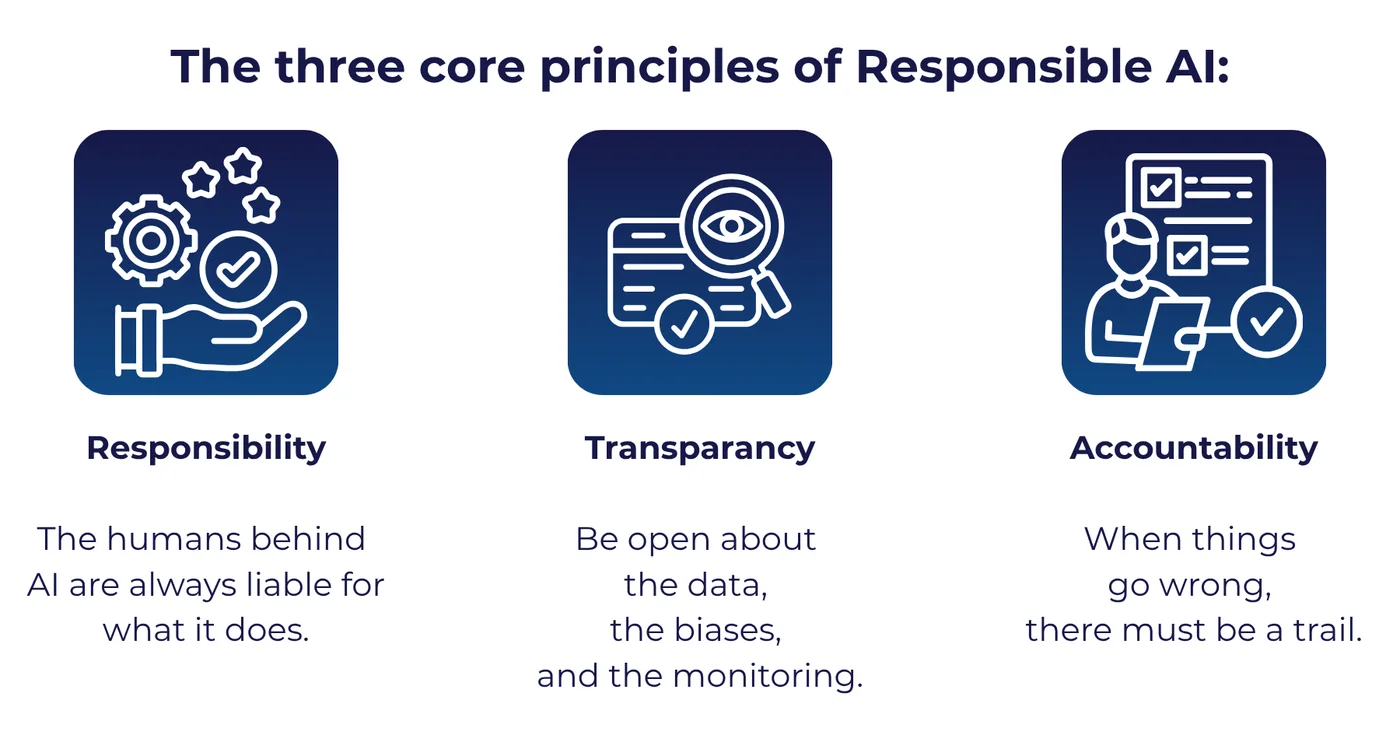
At its core, Responsible AI rests on three principles: responsibility, transparency, and accountability. These are practical requirements that shape how AI systems are built, deployed, and governed.
Responsibility: The Buck Still Stops with Humans
AI systems can make decisions, recommend actions, and learn from data, but they cannot be held responsible for what they do. That responsibility always sits with the humans who design, deploy, and use them.
This matters more than most businesses realise. When an AI system produces a harmful or incorrect output, responsibility falls either on the user (if the system performed as intended) or on the developer (if it malfunctioned). The existence of an AI in the chain does not dissolve human liability. All it does is distribute human responsibility.
This is why the design and implementation of AI systems need to be closely monitored. The people building and deploying these systems remain accountable for ensuring that they behave in accordance with relevant ethical and societal principles, regardless of what the system learns or does autonomously over time.
Transparency: Opening the Process, Not Just the Output
Transparency in AI means more than publishing a model card or explaining a prediction. It means being open about where the data came from, how the model was trained, what biases may exist, and how the system is monitored over time.
Two specific problems make transparency difficult in practice. The first is bias: when training data reflects historical prejudice, the model learns and reproduces it. The second is drift: when the relationship between inputs and outputs changes over time, and the model’s predictions become unreliable. Both require active monitoring and intervention.
Transparency has a human dimension too. When users believe they are speaking to a human, they extend a different kind of trust, sharing information they might otherwise withhold and interpreting responses through a social and emotional lens that does not apply to a machine. Deceiving users about the nature of what they are interacting with undermines informed consent. Any AI system that communicates with customers or supports internal decision-making should clearly identify itself. Users should never have to wonder. Transparency about the nature of AI builds trust.
Accountability: Explaining What Happened and Why
Accountability refers to the ability to explain, after the fact, what an AI system did and why. This is what is meant by “explainable AI”: not that every technical detail must be made public, but that when things go wrong, there is a trail. Logs, documentation, and audit mechanisms should make it possible to identify where an error entered the system.
For businesses, this is a governance consideration. As AI systems take on more consequential decisions, in credit, hiring, healthcare, and fraud detection, the ability to explain and contest those decisions becomes a legal and reputational necessity.
Why This Matters for Your Business Right Now
Responsible AI is sometimes framed as a constraint on innovation, but the opposite is true. Building responsibility, transparency, and accountability into your AI systems from the start means fewer costly corrections later, stronger stakeholder trust, and systems that are genuinely fit for purpose.
The question is not whether your business will eventually need to take Responsible AI seriously. It is whether you will do it proactively or reactively.